
England's Immigration Debate Explained | Causes & Facts
Why is immigration such a divisive issue in England? Explore the history, facts, political debate, asylum system and the challenges shaping modern Britain.
By Lily Begley
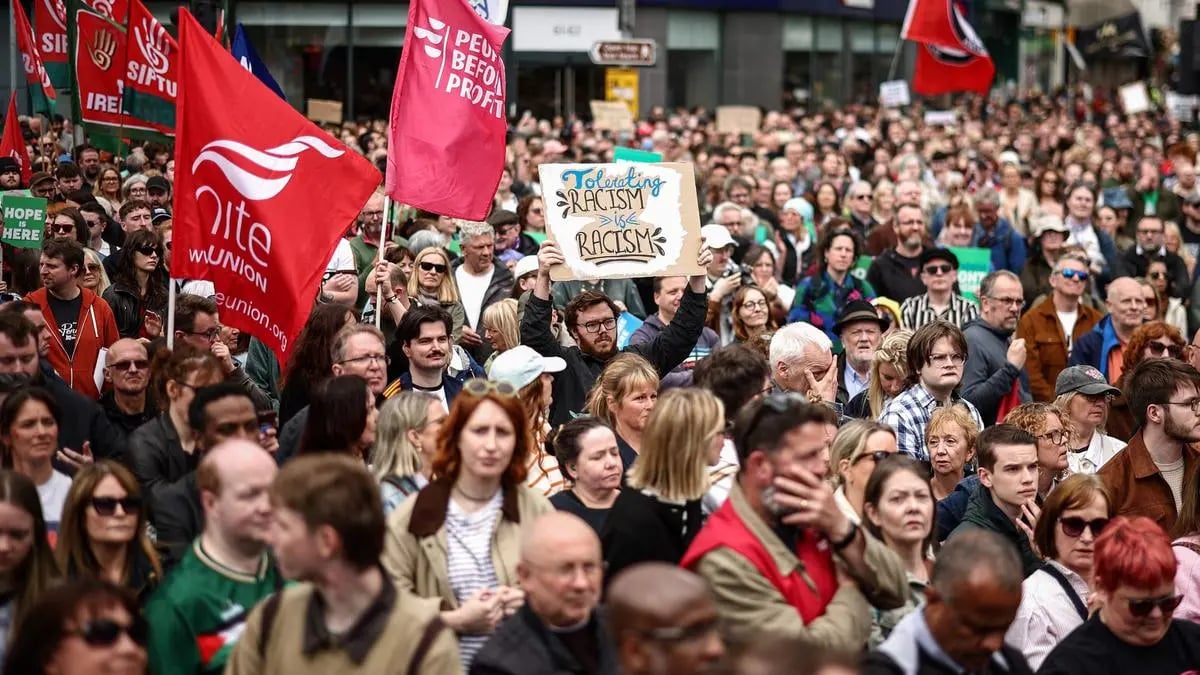

People take part in an anti-racism demonstration in central Belfast, Northern Ireland, on June 13, 2026, calling for calm after several nights of disorder following a June 8 knife attack. Thousands gathered for the rally after unrest in the city sparked by the stabbing. | Photo Credit: Henry Nicholls/AFP
England today feels increasingly divided over immigration. Across the country, protests against asylum seekers have become a regular feature of political life. Crowds carrying St George's flags have gathered outside hotels and accommodation centres housing asylum seekers, calling for stricter border controls and lower levels of immigration. While many protests remain peaceful, others have turned hostile and communities across England experienced some of the worst unrest seen in years.
The atmosphere has become increasingly uncomfortable for many immigrants and ethnic minority communities living in England. In the year ending March 2024, police recorded more than 98,000 racially motivated hate crimes in England and Wales, accounting for around 70% of all hate crimes. For many people immigration is no longer simply a political issue discussed in Parliament, but simply every day life.
To someone outside Britain, these arguments may appear to be about immigration alone. In reality, they are also about housing shortages, the cost of living, pressure on public services, political distrust and questions about national identity. Immigration has become a symbol of wider frustrations that many people feel about modern Britain.
As a third-generation immigrant living in England, I have watched these debates become increasingly personal. Through my job, I regularly interact with immigrants and people from a range of cultural backgrounds where many have spoken about feeling uncomfortable, unwelcome or anxious about the direction of public debate. Behind every headline are ordinary people trying to build a life, raise families and feel accepted in the country they call home.
To understand why England feels so divided today, it is important to understand how immigration became one of the most controversial issues in British politics.
Immigration is not new to Britain. For centuries, people have moved to England from different parts of the world. However, modern debates about immigration largely began after the Second World War.
Britain faced severe labour shortages after the war and needed workers to help rebuild the country. Thousands of people arrived from countries that were part of the British Empire and later the Commonwealth, particularly from the Caribbean, South Asia and Africa. These migrants played a major role in building modern Britain. They worked in factories, public transport, construction and hospitals. The National Health Service (NHS), one of Britain's most important institutions, relied heavily on migrant workers and continues to do so today. Around one in five NHS workers in England was born overseas.
Despite these contributions, immigration has remained politically controversial. Questions about identity, integration and cultural change have been debated for decades. The issue became even more significant after the expansion of the European Union in the early 2000s. Workers from countries such as Poland, Romania and Lithuania moved to Britain in large numbers and many communities experienced rapid demographic change. Many residents felt their towns were changing faster than they could adapt to.
Then, in 2016 Britain voted to leave the European Union and Immigration was one of the most important issues during the campaign. Supporters argued that leaving the EU would allow Britain to regain control of its borders, and opponents argued that immigration brought important economic and cultural benefits. Although Britain left the European Union, immigration did not disappear as a political issue but instead it became even more central to public debate.
A Brief History Of Immigration In Modern Britain
In recent years, much of England's immigration debate has focused on asylum seekers. An asylum seeker is someone who leaves their country and asks another nation for protection because they fear persecution, conflict or danger at home. Under international law, people have the right to seek asylum.
However, asylum has become one of the most controversial issues in British politics. Images of small boats crossing the English Channel frequently appear on mainstream news networks and in newspapers. Politicians regularly debate border security, illegal migration and asylum policy, while governments have introduced a series of measures aimed at reducing the number of people arriving through irregular routes.
For many people, these images create the impression that Britain is facing an unprecedented migration crisis.
Yet the reality is more complex.
Although small boat crossings receive significant media attention, asylum seekers represent only a small proportion of the UK's overall population. Many are fleeing war, persecution or instability in countries such as Afghanistan, Syria, Sudan and Iran. Because asylum seekers are often housed in hotels or temporary accommodation, they are highly visible within local communities and have increasingly become the focus of public frustration and political debate.
It would be easy to dismiss anti-immigration sentiment as simple prejudice. However, doing so would ignore the genuine concerns that many people have. England faces significant economic challenges — house prices have risen sharply, rents continue to increase, NHS waiting lists remain high and many young people feel home ownership is out of reach. Many people feeling they are working harder but receiving less in return.
When communities experience economic pressure, they often look for explanations. Immigration can become an easy target because it is highly visible and constantly discussed by politicians and the media, vulnerable to misconceptions.
Immigration is often blamed for problems such as housing shortages and pressure on public services, but the evidence suggests the picture is far more complicated. Researchers at the Migration Observatory have found that England's housing crisis is primarily the result of decades of underbuilding rather than immigration alone. While population growth can increase demand for housing, experts generally agree that the lack of new homes is a major cause of rising prices and rents.
Immigrants also play an important role in keeping essential services running. According to official workforce data, almost one in four hospital workers in the UK was born overseas, while around one in five workers across health and social care were born outside the country. Without migrant workers, both sectors would face even greater staffing shortages.
Another common misconception is that most immigration involves asylum seekers or people arriving illegally. In reality, most people who move to Britain come for work, study or family reasons, with research finding that more than three-quarters of recent migrants were workers, students or their dependants.
There is also a widespread belief that immigration is constantly increasing. However, official figures from the Office for National Statistics show that net migration has fallen significantly since reaching a post-pandemic peak in 2023, demonstrating that migration levels do not always move in the direction many people assume.
This does not mean immigration has no impact on communities. Population growth can place pressure on housing, schools and public services if governments fail to plan effectively. However, many of England's biggest challenges including the housing crisis, NHS pressures and the cost-of-living crisis have developed over many years and cannot be explained by immigration alone.
Understanding these facts is important because immigration has become a symbol of wider frustrations in British society. People may disagree about how much immigration the country should have, but the evidence suggests that solving Britain's biggest problems will require looking beyond immigration and addressing the deeper economic and political issues that affect the country as a whole.
The Facts Behind Immigration In The UK
Much of England's current debate over immigration can be traced back to two defining moments: the rise of Reform UK and the aftermath of the Southport murders in 2024.
With immigration sitting at the centre of its message, Reform UK has been one of the biggest political developments in recent years regarding immigration. The party has won council seats across England in the recent local elections and attracted support from voters who feel ignored by traditional political parties. But just forty eight hours following local the elections, three councillors and candidates resigned or were suspended following mounting scandals involving racist comments and extremist social media posts.
Supporters of Reform UK dismiss the party’s racist rhetoric, claiming they are only addressing concerns about border control, housing and public services that other parties have failed to tackle. However, the party’s messaging oversimplifies complex issues and encourages people to see immigration as the main cause of problems that have developed over decades. Whatever people's views of the party, its sudden success demonstrates how important immigration has become in modern British politics.
After the tragic murders of three young girls in Southport in 2024, false claims spread online that the suspect was an asylum seeker who had arrived in Britain by boat. The claim was untrue, but before accurate information could spread the misinformation had already been viewed by hundreds of thousands of people online. Violence erupted across England through riots and hotels housing asylum seekers were targeted and vandalised. Communities experienced unrest fuelled by anger, fear and misinformation. The events demonstrated how quickly false information can spread online and influence events in the real world.
The atmosphere has extended beyond social media and protests two years since the murder, in May this year approximately 60,000 people attended a major far-right anti-immigration rally in London. Walk in most towns and cities in England and you will find St George's Cross symbols painted on roundabouts and public spaces, as a response to the arrival of asylum seekers and an attempt to send a message about who they believe truly belongs in English communities. For some immigrants and ethnic minority residents, these displays contributed to a feeling of unease at a time when tensions are already high.
Another criminal cases that shaped public attitudes towards immigration and public safety was the murder of 18 year old Henry Nowak in Southampton in 2025. The case received widespread media coverage after police initially accepted a false account given by the attacker, Vickrum Digwa, that Henry had been the aggressor in a racially motivated attack and arrested Henry while he was dying from stab wounds. Although the case was primarily about a violent crime and a controversial policing response rather than immigration policy itself, it became heavily politicised and was widely discussed online as evidence of broader failures in policing and public safety. Cases such as this often have a significant impact on public opinion because they receive extensive media attention and can reinforce existing concerns about crime, security and government control of borders, even though individual crimes should not be used to judge entire migrant communities.
The Rise Of Reform UK And Criminal Injustice


Several people gather outside Southampton Police Station in England to protest the fatal stabbing of British teenager Henry Nowak, who was handcuffed despite claiming to be the victim of the attack.
A factor often overlooked in immigration debates is education. Many young people in England receive limited education about immigration, asylum or the history of migration to Britain. Schools teach major historical events, but the role migration has played in shaping modern Britain is often explored only briefly.
As a result, many people learn about immigration primarily through politicians, newspapers and social media. This can create a gap that is easily filled by misinformation, stereotypes and political bias. A better understanding of migration would not necessarily make everyone agree on immigration policy, however it could help create a more informed and constructive debate.
The Role of Education
In many towns across England, high streets now include Polish supermarkets, Turkish barbers, South Asian grocery stores and restaurants serving food from around the world. These businesses have become a normal part of everyday life in modern Britain. Some people see this diversity as a positive reflection of a multicultural society, but others feel their towns have changed rapidly and no longer resemble the communities they grew up in. This disagreement sits at the heart of many immigration debates, as the issue is often not simply about numbers but about identity and belonging.
Following anti-immigration protests and riots, there have been reports of immigrants facing verbal abuse and feeling unsafe in public. Some asylum accommodation has been targeted, while members of minority communities have spoken about feeling increasingly anxious. Importantly, hostility is not always directed only at immigrants as some British-born people from ethnic minority backgrounds have reported being targeted because of their appearance, religion or perceived immigration status. In some cases, people have been judged not by who they are, but by assumptions about where they come from.
Through my personal work at my current job, I have spoken with immigrants who describe feeling increasingly uncomfortable when immigration dominates the news. Some worry about how they are viewed by others and others feel deeply anxious when protests take place near their communities. Many came to Britain legally, have jobs, families, and deep roots in the country. Yet when immigration becomes the focus of political debate, they often feel they are being discussed as problems rather than people.
Lost National Identities
In my county, a small market town in Norfolk called Watton became the focus of local controversy after rumours spread online that a local Hotel would be used to house asylum seekers in 2025. The rumours were false, and the local council later confirmed that the hotel was simply being refurbished and was not being considered for migrant accommodation. However, by that point protesters had already gathered outside the site and blocked access to contractors.
Less than a year later, this summer Watton has found itself at the centre of the debate again when asylum seekers relocated from accommodation in Norwich were moved into the town. The decision sparked protests and heated discussion across local social media groups, with community pages filled with speculation and accusations about immigrants. People shared photographs of individuals that they believed were asylum seekers, simply because they belonged to an ethnic minority. In many cases there was no evidence that the people being photographed were migrants at all.
For immigrants and ethnic minority residents, this created a sense of unease. Many people who had lived and worked in Norfolk for years suddenly found themselves caught up in a debate that treated them as outsiders. Some spoke of feeling unwelcome in their own community, while others worried about the racist rhetoric they were seeing online and in public discussions.
What also struck me was how difficult it became to have a balanced conversation. In local Facebook groups and comment sections, people who questioned anti-immigration claims or expressed sympathy for asylum seekers were often met with hostility. Some were accused of being out of touch, while others faced personal attacks simply for defending people they felt were being unfairly targeted. As the debate became increasingly polarised, meaningful discussion became more difficult. Instead of focusing on facts, housing policy or how communities could support one another, conversations often descended into anger and accusations.
The issue was no longer just about immigration policy but it became a question of who belonged, who was welcome and who felt able to express their views without fear of backlash. In that environment, both immigrants and those who spoke up for them could find themselves feeling isolated.
My Local Communities Reality
Perhaps the most important lesson from England's immigration debate is that people need a better understanding of the issue itself.
For many people, their knowledge of immigration comes from political speeches, newspaper headlines or social media posts rather than education. As a result, complex issues are often reduced to simple arguments and slogans. Immigration is discussed constantly, yet many people know very little about how the asylum system works, why people migrate, or the role immigrants have played in shaping modern Britain. A more informed debate would not mean that everyone agrees, however better education could help people separate facts from misinformation and encourage discussions based on evidence rather than fear. It is also critical to recognise the contributions immigrants have made to Britain. Modern England would not look the way it does today without generations of people who arrived from other countries. Today, millions of immigrants continue to play an important role in communities across the country.
This does not mean concerns about immigration should be ignored. Governments have a responsibility to manage migration effectively and ensure that housing, schools and public services can meet demand. But recognising these challenges should not come at the expense of recognising the people who contribute to British society every day. England’s future will not be shaped by fear or division alone. It will be shaped by how willing people are to understand one another, challenge misinformation and have honest conversations about immigration. Only then can the country move beyond anger and towards solutions that reflect both the challenges and the contributions that immigration brings.
Englands Uncertain Future
Author: Lily Begley
Editor & Publisher: Lucía Lobato
© 2026. Unfolding The World. All rights reserved.
UNFOLDING THE WORLD
Because the world is complicated,
But understanding It shouldn´t be.

