Does Education Reproduce Social Inequalities?
Education is often seen as the key to success, but does everyone start with the same opportunities? This article examines cultural capital, social mobility and the role education plays in shaping inequality.
Education: A Right Not Everyone Can Access
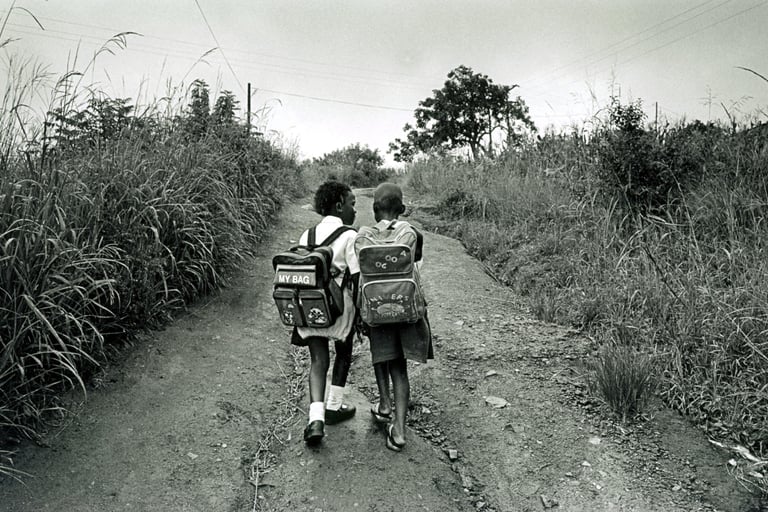
For someone who has to go to school daily, work on assignments, and do their homework, it can absolutely feel like a hassle. While school can be tiring, a shift in our perspective can really change how we think about it. In reality, even primary education is a right that many people still do not have access to. Though globally most children are enrolled in primary school, this number tends to decrease as they move into higher levels of education.
The number of adolescents getting access to proper education can vary depending on an area's economy or the child's gender. Regionally, education remains a privilege, especially across Sub-Saharan Africa. Although globally most girls have the same right to education as boys, in some countries they are still at a disadvantage or even denied education altogether. Afghanistan, for example, is currently the only country in the world where girls are formally prohibited from secondary and higher education.
But why does this happen, especially still in 2026? Pierre Bourdieu, a French sociologist, anthropologist and philosopher, coined the concept of cultural capital as one way of answering this question.
Pierre Bourdieu and the Three Forms of Cultural Capital
Cultural capital can come in three forms: embodied, objectified and institutionalized. This may sound complicated, but it is actually quite logical.
When I talk about cultural capital, I mean all the things related to a person's education, lifestyle, knowledge and skills that cannot simply be bought but help people navigate society and often earn them a higher position within it.
Embodied cultural capital refers to someone's skills, competencies and knowledge, which are acquired through long-term exposure to a cultural environment. This means it cannot simply be passed directly from one person to another. An example of this is linguistic capital, which refers to one's speech style, communication skills and mastery of language.
Objectified cultural capital is much more material. It refers to the possession of cultural goods such as books, works of art or musical instruments. However, owning these items does not automatically mean someone can benefit from them culturally. A certain level of knowledge and ability is required to interpret and use them effectively. Unlike embodied cultural capital, these goods can be transferred or exchanged much more easily.
Lastly, institutionalized cultural capital refers to the formal recognition of a person's skills by institutions. For example, taking a Cambridge exam demonstrates a certain level of English proficiency. Academic qualifications function as proof that a person possesses specific knowledge or abilities, which can be particularly valuable in the job market.
Unequal Access to Educational Resources
But why are all these concepts useful?
They allow us to compare different genders, regions and social groups in terms of how likely they are to acquire cultural capital. Once we examine the data, it becomes clear that access to educational resources and opportunities remains highly unequal across the world.
Academic resources are still distributed unevenly, as shown in the chart below:
The UNDP uses the Atkinson Index to measure how unevenly educational attainment is distributed within a country. It estimates the amount of human capital lost due to unequal distribution and converts it into a value between 0 and 1.
The lower the value, the more equally educational resources are distributed. These resources include textbooks, learning materials, websites and other tools used for education.
The key takeaway from this chart is that educational opportunities tend to be distributed more unequally in low-income countries.
Differences Between Educational Systems
It is important to remember that educational systems differ significantly around the world.
To better understand this, we can compare two countries with very different Atkinson Index scores: Germany (0.04 in 2023) and Sudan (0.42 in 2023).
Germany has a highly developed education system with near-universal literacy, compulsory schooling and broad access to secondary and tertiary education. Educational attainment is relatively evenly distributed across the population, which contributes to its low Atkinson Index score. However, inequalities still exist, particularly regarding socioeconomic background and migration status.
Sudan shows a much more unequal distribution of educational opportunities. Access to education varies significantly depending on household income, whether someone lives in an urban or rural area, their region and their parents' educational background. Research has shown that these circumstances account for more than half of the observed inequality. Many adults have little or no formal education, while only a smaller proportion of the population has completed secondary or higher education.
Limited Social Mobility
But aren't we already used to inequality? There are rich people and poor people. You just have to work hard, right?
Easy to say.
In reality, limited social mobility is one of the biggest challenges. Social mobility refers to a person's ability to improve their socioeconomic status throughout their lifetime. In societies with high social mobility, children from low-income families have a realistic chance of achieving higher levels of education, income and professional success. When mobility is limited, people's opportunities are much more strongly shaped by their family's circumstances.
The simplest way to imagine this is as a ladder:
The bottom rungs represent lower-income positions, while the top rungs represent greater wealth, education and influence. In societies with limited mobility, climbing this ladder becomes much more difficult because some people begin with advantages that others simply do not have.
Factors contributing to this include unequal access to education, economic barriers, the importance of social networks and discrimination based on race, gender, ethnicity, disability, location and income.
The consequences extend beyond individuals. Limited social mobility can increase inequality, reduce social cohesion and prevent talented people from reaching their full potential. It can also slow economic and societal growth because society is not making full use of its human talent.


Education as a Tool of Social Reproduction
From everything discussed so far, education may seem like a pathway to a better life. However, many sociologists argue that education can also help preserve existing inequalities. This idea is known as social reproduction. Schools may unintentionally pass advantages and disadvantages from one generation to the next instead of fully eliminating them. A useful way to imagine this is as a race:
Some students begin with advantages such as educated parents, financial security, access to books, tutoring and strong support at home. Others start with far fewer resources and opportunities. Even though everyone runs on the same track, they do not all start from the same position. Some students face obstacles that others never encounter.
Because schools often reward the language, knowledge and behaviours more common among middle- and upper-class families, students from these backgrounds tend to achieve higher academic success and gain more qualifications.
As a result, cultural capital is acquired unequally. Children from advantaged backgrounds are therefore more likely to achieve educational success and enter well-paid careers, while those from disadvantaged families often face greater obstacles. This contributes to social class differences continuing across generations.
"Even though everyone runs on the same track, they do not all start from the same position."
Final Thoughts
Author: Laura Juhász
Editor & Publisher: Lucía Lobato
The key takeaway from this article is not that education is inherently unfair or that success is impossible for disadvantaged students.
Rather, educational achievement is shaped by more than individual effort alone. Access to cultural capital, educational resources and opportunities remains unevenly distributed across social groups.
If education is to fulfil its role as a force for equality, these structural inequalities must first be recognised and addressed.
At the same time, higher inequality rates in parts of Africa or Asia should never be interpreted as a reason to judge the people living there. Nor should we judge anyone based on their level of education or cultural background.
The goal is simple: reduce inequality in education, not reinforce it.
© 2026. Unfolding The World. All rights reserved.
Understanding the World, One Story at a Time.
About Us
Our Team
QUICK LINKS