
What Is a Treaty? A Beginner's Guide to International Law
Learn what a treaty is, how negotiations and ratification work, and why countries sign—or sometimes break—international agreements.
By Veronika Mirasova
3 min read
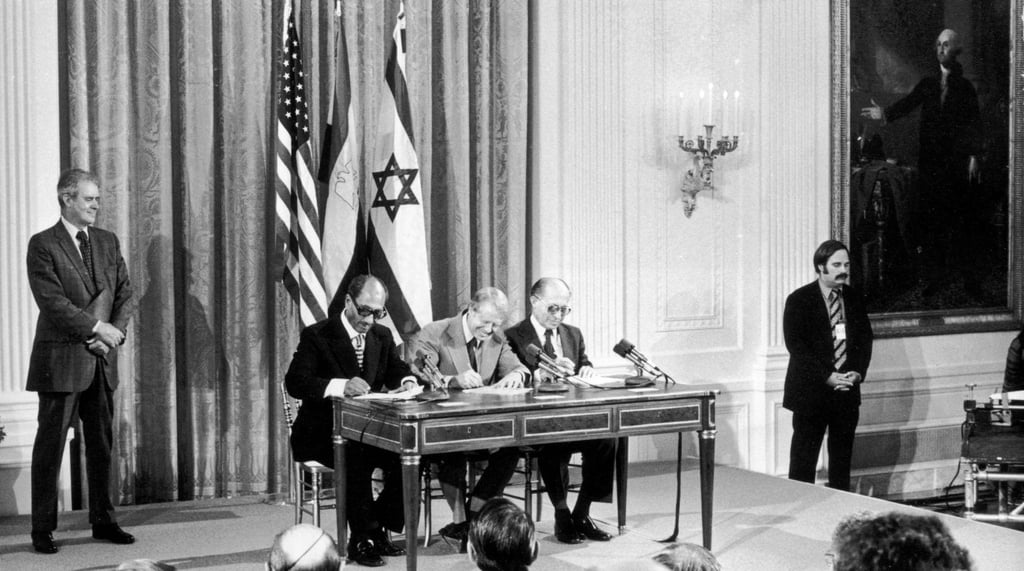

Egyptian President Anwar Sadat and Israeli Prime Minister Menachem Begin sign the Camp David Accords at the White House on 17 September 1978, with U.S. President Jimmy Carter standing behind them.
Hello, my dear reader! Today we are going to talk about a treaty. It may sound dreadful; however, it is actually much easier than you might think. So, what is a treaty, actually?
What Is a Treaty and Why Does It Matter?
According to international law, a treaty is an international agreement concluded in written form between two or more States (e.g. countries, NGOs, the UN) and is governed by international law. Let’s imagine a simple situation: you and your enemy have been fighting each other for years, and then one day you both decide to stop and treat each other politely. That’s an understandable definition of a treaty.
Okay, and since we know what a treaty is, let's move forward to the next point of this article. Now I’m going to ask you: do you know what negotiation and ratification are? No? So let me explain!
Negotiation is the process by which States bargain in an effort to reach a treaty. Go back to our example of the fight between you and your enemy. Once you’ve decided to act politely, you have to talk to each other so that you can reach an agreement and maybe even become friends. See the connection?
Meanwhile, ratification is the process by which a State declares its consent to be bound by a treaty. It’s like after you’ve reached the agreement not to be enemies anymore, and then, while talking to each other, you proudly say that you’re not going to hate your enemy anymore because of your agreement.
Let’s sum up. After a long period of hating each other, you decide to stop fighting and talk to each other (negotiations). After your conversation, you reach an agreement not to be enemies anymore (treaty), and finally, you promise each other that you will remain neutral and not fight again in the future (ratification). Of course, in the real world, the whole process is much more complex, but at least now you understand the core idea behind it.
The Rules Behind Every Treaty
A logical question may come to your mind: “What set of rules regulates these processes?” The obvious answer is international law. It is a set of rules and principles governing the relations and conduct of States. Issues that fall under international law include trade, human rights, diplomacy, environmental preservation, and war crimes.
Now, enough about theory—let me tell you about some of the most significant treaties in world history. In my opinion, there are no more or less important treaties because all of them marked the end of cruel events.
TREATY OF VERSAILLES
It was signed more than a century ago, in 1919, as the most important treaty of World War I. It ended the state of war between Germany and most of the Allied Powers. It was signed at the Palace of Versailles, exactly five years after the assassination of Archduke Franz Ferdinand, which led to the war. It entered into force on January 10, 1920, and gave some German territories to neighbouring countries while placing other German territories under international supervision.
PARIS AGREEMENT
The Paris Agreement is a legally binding international treaty on climate change. It was adopted by 195 Parties at the UN Climate Change Conference (COP21) in Paris, France, on 12 December 2015. It entered into force on 4 November 2016. Its overarching goal is to hold “the increase in the global average temperature to well below 2°C above pre-industrial levels” and pursue efforts “to limit the temperature increase to 1.5°C above pre-industrial levels.” The Paris Agreement is a landmark in the multilateral climate change process because, for the first time, a binding agreement brought nations together to combat climate change and adapt to its effects.
If Treaties Exist, Why Do Countries Still Break Them?
And the final question… If there is a peaceful way to achieve peace, why don’t all countries follow it? Honestly, the reason is quite simple: national interests.
Countries don’t always follow international treaties because the international system lacks a centralized global police force or supreme court to enforce them. Every independent nation has ultimate authority over its own territory and citizens. A treaty is essentially a voluntary contract; if a country decides that a treaty no longer serves its national interests, it can choose to violate, bypass, or formally withdraw from the agreement.
Thanks for reading! I hope you liked it. Have a nice day, and stay tuned!
Author: Veronika Mirasova
Editor & Publisher: Lucía Lobato
© 2026. Unfolding The World. All rights reserved.
UNFOLDING THE WORLD
Because the world is complicated,
But understanding It shouldn´t be.

