
Are Peace Treaties Really Peaceful? The Politics Behind Ending Wars
Peace treaties can end wars—or plant the seeds for future conflicts. Explore the hidden politics behind famous agreements like the Treaty of Versailles.
By Sofía López
4 min read
European leaders sign the Maastricht Treaty on 7 February 1992, establishing the European Union and laying the foundations for closer political and economic cooperation.


What's the point of wars? I think that's a question we've all asked ourselves—or someone else—at least once. Of course, the answer will vary depending on who you ask. But in the end, what most national leaders want is more: more power, more territory, and more control.
As citizens, when we hear about a new peace treaty ending a conflict, our first reaction is usually positive. It means the suffering is finally going to end, right? There will be no winners or losers because everyone will agree to the conditions. Or will they? But is violence only about bombs, weapons, and physical harm?
Of course not. Sometimes, "peace" treaties are simply another way of gaining power, territory, and control—this time through words instead of weapons.
Probably the most famous and controversial peace treaty is the Treaty of Versailles. After World War I, France, the United Kingdom, and the United States signed this treaty with Germany. However, the treaty had been drafted weeks earlier without Germany's participation.
This is where the problems began. Germany wasn't even given the opportunity to defend its own interests, and when its representatives expressed dissatisfaction with the conditions imposed on them, they were threatened with the possibility of another war.
The Treaty of Versailles placed the blame for the war entirely on Germany. It's true that Germany wasn't innocent, but it certainly wasn't the only country responsible (or the one solely responsible for starting the conflict). Both sides caused enormous destruction.
Some of the treaty's conditions required Germany to hand over the regions of Alsace, Lorraine, Eupen, Malmedy, and Gdańsk to neighboring countries; reduce its army from around 500,000 soldiers to just 100,000; abolish compulsory military service; leave its western border with France demilitarized; and, perhaps most importantly, pay 132 billion gold marks in reparations—roughly equivalent to €526 billion today.
In short, the Treaty of Versailles left Germany economically devastated.
The Treaty That Helped Shape the Future

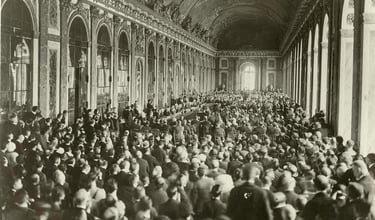
Delegates sign the Treaty of Versailles in the Hall of Mirrors at the Palace of Versailles on 28 June 1919, officially bringing World War I to an end.
I think that when we talk about international conflicts, we often forget that countries aren't abstract entities. They are made up of millions of people.
It wasn't the German government alone that paid the price for the Treaty of Versailles—it was ordinary German citizens. They paid both metaphorically and literally. Unsurprisingly, widespread poverty, resentment, and frustration followed. These conditions became some of the factors that contributed to the outbreak of World War II (alongside many others, such as the rise of totalitarian regimes—but that's another story).
This isn't an isolated case. There have certainly been treaties that have worked well—or at least didn't make the situation worse. However, peace agreements have often been used as political tools or even as instruments of propaganda.
Who Really Pays the Price?
If we look at several major peace treaties from the last century, we may notice that the United States has frequently played a role. Besides the Treaty of Versailles, there are the Camp David Accords (Egypt and Israel, 1978), the Dayton Accords (Bosnia, 1995), the Good Friday Agreement (Northern Ireland, 1998), and the Comprehensive Peace Agreement in Sudan (2005), among many others.
Personally, I found this striking. After doing some research, I discovered that, thanks to U.S. mediation and support, many of these agreements included clauses that favored American interests. In some earlier cases, such as Camp David and Dayton, they also helped limit Soviet influence during the Cold War. At the same time, these agreements strengthened the image of the United States as a global promoter of peace.
Whether intentional or not, treaties can serve diplomatic, strategic, and political purposes at the same time.
Peace... or Politics?
As I mentioned before, countries are not abstract entities—they are made up of ordinary people, many of whom have little or no influence over the decisions made by politicians.
Regardless of the political interests behind them, the most important purpose of any peace treaty should be to create lasting peace for those citizens.
History shows us that, for this to happen, every side involved must have a genuine opportunity to participate in the negotiations. No country should leave the table feeling completely humiliated. Lasting peace is far more likely when every party gains something from the agreement.
Some treaties demonstrate that this is possible. The Ottawa Convention (1997), in which 133 countries agreed to ban anti-personnel mines, has led to the destruction of more than 40 million landmines. One reason for its success was that its main objective was saving lives rather than advancing political interests.
Another important example is the Maastricht Treaty (1992), which established the European Union.
A Lasting Peace Requires Every Voice
The point of this essay is simple: a peace treaty isn't always as peaceful as its name suggests. Political leaders will always look for ways to gain more power. Sometimes they do it with weapons. Other times, they do it with words.
That's why it really frustrates me when people say history is useless.
History isn't just our past—it shapes our present and influences our future. Even today, there are conflicts waiting for peace agreements, or negotiations already underway. Gaza, for example, urgently needs a fair and dignified agreement. Other conflicts continue to remind us how important successful diplomacy can be.
Keep learning about global affairs. The more informed you are, the harder it becomes for anyone to manipulate you.
History Doesn't End When the War Does
Author: Sofía López
Editor & Publisher: Lucía Lobato
© 2026. Unfolding The World. All rights reserved.
UNFOLDING THE WORLD
Because the world is complicated,
But understanding It shouldn´t be.

