
"My greatest fear is not spiders or heights. It's enforced disappearances in Mexico."
Mexican student Andrés Moreno reflects on Mexico's missing persons crisis, explaining how enforced disappearances have transformed daily life and affected thousands of families across the country.
By Andrés Moreno
4 min read


A group crosses Paseo de la Reforma in Mexico City on July 6, 2026, passing hundreds of photographs of missing women, men, and children displayed along a wall to draw attention to Mexico's crisis of more than 130,000 disappeared persons during the international spotlight of the 2026 FIFA World Cup. (Photo: GSR en Español/Rhina Guidos)
When people ask me what my greatest fear is, I always answer without hesitation: spiders and heights. The truth is, however, that my greatest fear is not a roller coaster reaching 120 km/h or a spider I will probably never encounter except in a viral social media post claiming it is the world's deadliest. My greatest fear is something far more heartbreaking: enforced disappearances in Mexico.
Disappearances are no longer isolated incidents. They have become a nationwide crisis affecting every corner of the country. Over the past twenty years alone, more than 130,000 people have never returned home. They were parents, children, siblings, cousins, grandparents, friends—people whose absence has left families searching for answers and an entire nation forced to imagine the unimaginable.
The numbers reached shocking levels in 2025. According to Mexico's National Registry of Missing and Unlocated Persons (RNPDNO), more than 13,000 people disappeared that year—an average of at least 35 people every day, or 1.4 every hour. Every time a high school class comes to an end, another family begins searching for someone they love.
A mother who left home to buy groceries. A father who went to the corner store to buy bread. A daughter who took her dog for a walk. A grandfather who went out for his daily walk following his doctor's advice. None of them imagined it would be the last time they would be seen. In an instant, they became part of a statistic.
Some of those who disappear are young people lured by false job offers and forced into criminal organizations. Others are women abducted from the streets and trafficked. Some are kidnapped so their families can be extorted, only to be discarded once they are no longer considered useful. These are only a fraction of the possibilities that haunt the families of those 130,000 missing people. It is a reality that is both painful and terrifying—a reality that has reshaped everyday life in Mexico and permanently changed the lives of countless families.
My Greatest Fear: Our Reality
For the most part, the search for missing persons is not led by the government, but by relatives who have formed volunteer search collectives. According to Amnesty International, these groups are made up primarily of women, and by 2024 there were an estimated 200 family-led search collectives across the country.
Their work is anything but easy. These movements were born out of frustration with widespread impunity and the lack of effective institutional action.
Members of these collectives have faced discrimination, violence, threats, and neglect—not only from criminal organizations but, at times, from the very institutions meant to protect them. Some have been beaten, shot, tortured, extorted, threatened, or even killed simply for carrying out a task that should never have fallen on their shoulders.
Many have taught themselves forensic science, psychology, and law. They have dedicated their lives to searching for those they love, entering dangerous areas, excavating suspected burial sites, recovering human remains, and continuing despite overwhelming obstacles, driven by the hope of finding their loved ones—even if only to finally bring them home.
"What if they actually do?" Recently, this question has gone viral on social media in reference to the FIFA World Cup—a lighthearted debate that, for some reason, has been treated as deeply important.
But what if they do find a missing brother? What if they do find the five-year-old girl who disappeared while playing in a park?
Those are the questions that truly matter.
"The ball is coming home," say the posters celebrating football. Perhaps. But 130,000 people still haven't come home. And despite this reality, one attitude continues to persist in society: "It doesn't affect me."
When Fear Becomes Routine
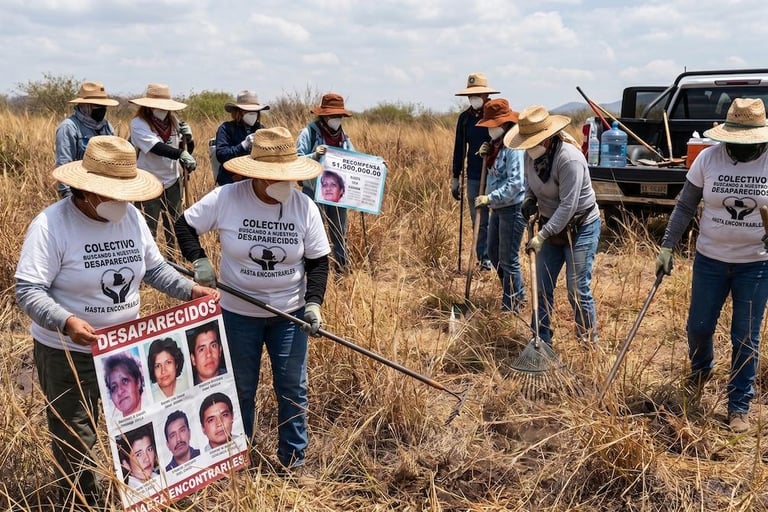
Members of a search collective comb a rural area in Mexico for evidence of missing persons. Family-led groups have become a vital part of the country's search efforts.
Ever since my sister and I were children, our parents taught us safety habits that we rarely questioned: "Always tell us who you're with and where you are," my mother reminds us whenever we go out with friends: Share your location at all times. If you go somewhere else, let us know," my father adds.
Taking a photo of a taxi's license plate before getting in and sending it to someone. Avoiding going out alone at night, especially far from home. Sending the simple message, "I made it," after arriving safely. These have become routine habits for millions of people. "Better safe than sorry" has become an unwritten rule in countless Mexican households.
A disappearance is not only a personal tragedy—it is an endless state of uncertainty. Are they still alive?" is the question families ask every single day. "What were they involved in?" is the question that unfairly stigmatizes the victim.
When someone disappears, the crime does not affect only one person. It tears apart everyone whose life was connected to theirs. According to Mexico's National Protocol for the Search of Missing and Unlocated Persons, every hour is crucial during an investigation.
Every second matters.
Over the course of my lifetime, more than 110,000 people have disappeared in Mexico.
And in the time it took you to read this article, several more families have likely begun searching for someone they love.
Growing Up Learning How Not to Disappear
Author: Andrés Moreno
Editor & Publisher: Lucía Lobato
© 2026. Unfolding The World. All rights reserved.
UNFOLDING THE WORLD
Because the world is complicated,
But understanding It shouldn´t be.

